Why Standardized Checklists Are Vital
When a commercial fleet operates across multiple depots in Hamburg, Lyon, Antwerp, and Milan, local cleaning quality often swings wildly between immaculate and unacceptable. Without an objective standard operating procedure (SOP), one depot supervisor may accept a water-spotted rear door while another rejects a slightly dusty rubber mat.
Standardized detailing checklists eliminate subjectivity. They transform aesthetic vehicle presentation into a measurable, verifiable operational key performance indicator (KPI). Detailers know precisely what steps must be executed, and fleet supervisors have an indisputable scorecard to audit work before vehicles depart on high-visibility delivery routes.
The 360-Degree Exterior Audit Walk-Around
Trained inspectors perform an audit walk-around in a counter-clockwise circle beginning at the driver-side A-pillar, adhering to five primary visual zones:
- Zone A (Front & Driver Vision): Windscreen clarity, wiper blade rubber hygiene, headlamp lens transparency, front radar/sensor surfaces, and bug splatter removal from front bumper and radiator cooling vanes.
- Zone B (Driver Side Flank): Mirror housings, door handles, side indicator repeater lights, corporate branding vinyl adhesion, wheel rims, and tire sidewall conditioning without sling.
- Zone C (Rear Doors & Cargo Threshold): Rear window optical check, high-mounted brake lamps, registration plate readability, barcode/QR delivery markers, and taillight assembly de-greasing.
- Zone D (Curb Side Flank): Sliding cargo door tracks, side rub rails, auxiliary step cleanliness, and fuel/AdBlue cap overflow cleanup.
- Zone E (Chassis & Mechanical Clearances): Mudflap securement, underbody wheel arches, exhaust heat shield clearance, and air tank drain cleanliness.
Fleet Detailing Quality Audit Scorecard Matrix
| Inspection Category | Pass Standard (100%) | Minor Defect (Correction Needed) | Critical Failure (Re-Wash Required) |
|---|---|---|---|
| Glass & Optical Surfaces | Zero haze, streak-free interior and exterior | Light perimeter water spotting outside wiper swept area | Oily film or glare hindering forward night vision |
| Livery & Painted Panels | Uniform gloss, zero road film when wiped with dry white towel | Slight static dust on rear roof lip | Visible traffic film, tar splatter, or lifted wrap corners |
| Cab Touchpoints | Zero grease, neutral scent, sanitized touch surfaces | Dust in cup holder bottom | Sticky residue on steering wheel, gearshift, or pedals |
| Wheel Assemblies | Alloy or steel faces free of black brake dust | Light dust in lug nut recesses | Heavy brake dust caking, dirty unwashed tires |
Mobile App and Digital Audit Integration
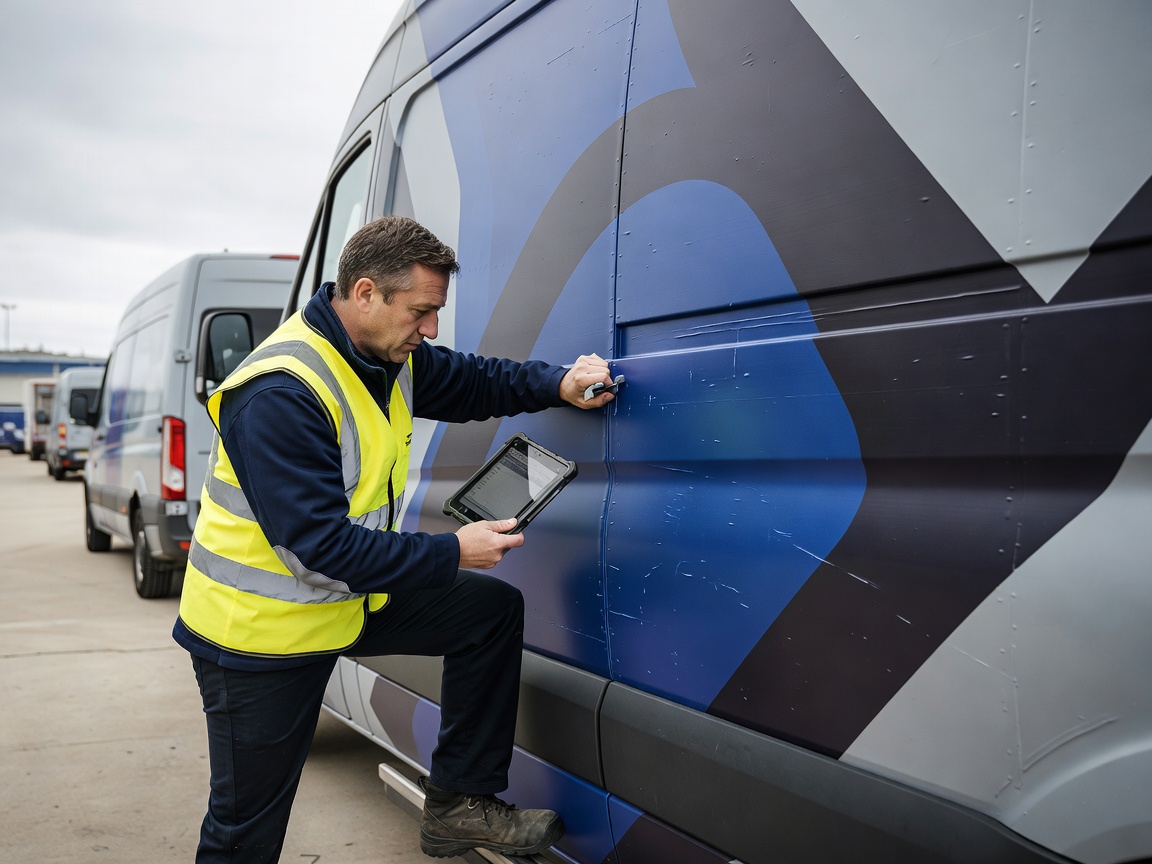
Paper clipboards frequently end up misplaced or soaked on wash bays. Leading European logistics operations transition their checklist workflows to lightweight digital mobile applications. Detailers take timestamped photos of vehicle flanks upon arrival and completion.
Digital records create an automated audit trail. If a vehicle returns with paint scratches or damaged mirrors, managers can cross-reference the pre-wash audit images to verify whether damage occurred in the depot or on the road, settling driver accountability quickly and fairly.
Internal Fleet Detailing Daily Sign-Off Checklist
- Vehicle Registration and Depot ID logged accurately.
- Driver-side floor rubber washed, dried, and securely refastened to anchor studs.
- All door apertures, door jambs, and rubber drains wiped dry to prevent winter freezing.
- Telematics display screen cleansed with anti-static microfiber.
- Supervisor signature or digital NFC sign-off recorded before vehicle dispatch.