The Cab as a Workplace Environment
In contemporary European logistics, commercial fleet cabins accommodate multiple drivers across day and night shift rotations. Over hundreds of operating hours, driver cabs accumulate fine street particulate, food organic waste, spilled beverages, perspiration, and biological pathogens. This creates an unhygienic microclimate that degrades air quality and drives driver dissatisfaction.
Treating cab cleaning as a rapid trash removal step fails both the vehicle asset and the human operator. Proper commercial interior detailing combines systematic allergen reduction, deep extraction of dense heavy-duty fabrics, anti-microbial disinfection of high-touch switchgear, and neutral matte finishing on safety-critical instrument clusters.
Critical High-Touch Sanitation Matrix
Cross-contamination across multi-shift fleets presents an occupational health hazard. Our protocol identifies key touchpoints that undergo hospital-grade, non-bleaching disinfectant wipe-downs:
- Steering Wheel & Adjustment Collet: The highest pathogen density zone, requiring non-slip cleaner that leaves zero silicone greasiness.
- Transmission Selector & Handbrake Lever: Often detailed with soft detail brushes to extract debris from rubber boots and shift gates.
- Tachograph Controls & Fleet Telematics Screens: Cleaned using optical-grade, alcohol-free formulations that prevent clouding of capacitive touch displays.
- Seat Belt Webbing & Anchor Latches: Immersed in mild surfactants and dried flat to remove skin oils without compromising the tensile integrity of the synthetic nylon weave.
- Overhead Storage Latches & Door Release Handles: Sanitized with dry vapor steam (140°C) at low pressure to kill bacteria in microscopic crevices.
Deep Textile & Heavy-Duty Vinyl Extraction
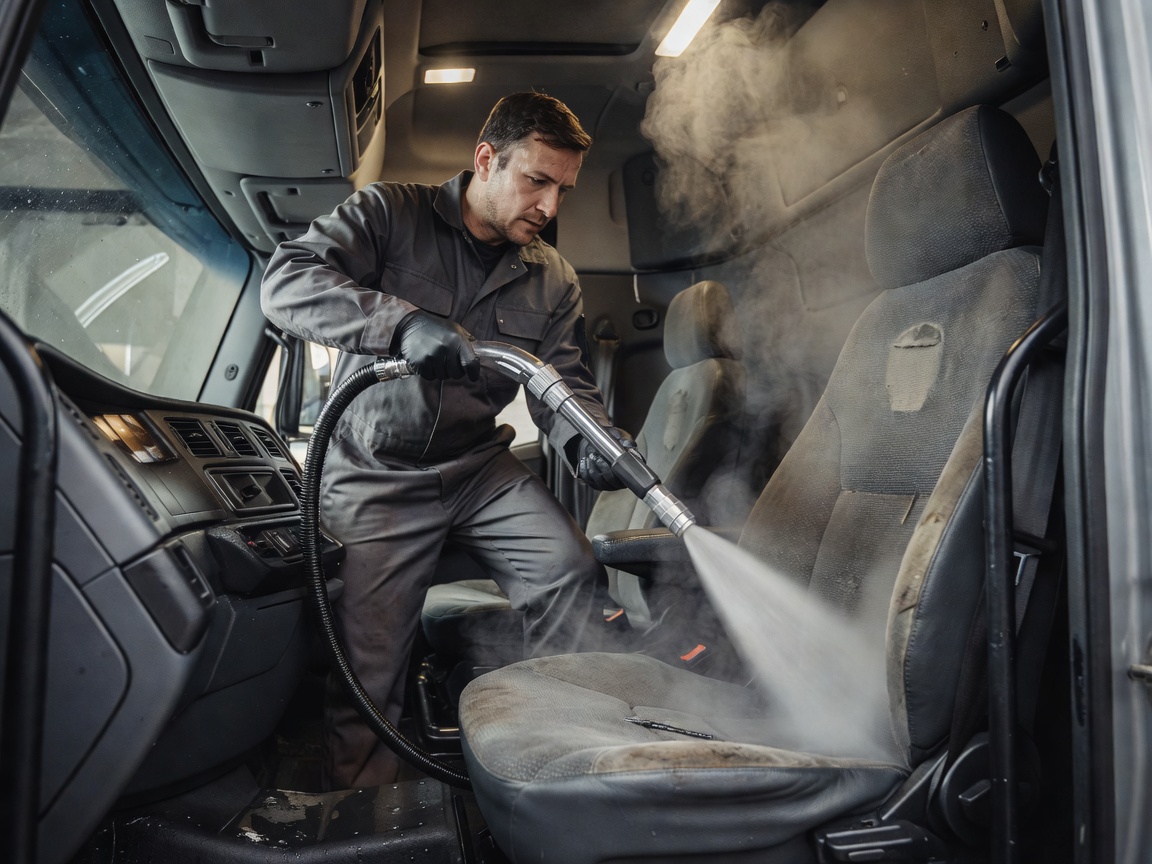
Commercial seats are subjected to immense abrasion from work wear, industrial tools, and moisture. Traditional surface wiping simply drives grime deeper into the polyurethane seat foam. We employ dual-motor heated commercial extraction machinery operating at 70°C water temperature.
By injecting an eco-certified enzyme surfactant into the upholstery and instantly drawing it out under 250 mbar vacuum lift, we remove embedded sweat, coffee spills, and diesel soot. Crucially, industrial high-velocity air movers are positioned inside the cab for 20 minutes post-extraction, ensuring seats are bone-dry before driver handover. This completely eliminates the threat of mildew and mold growth in closed cabs.
Interior Intervention Cycles for Commercial Fleets
| Tier Level | Frequency | Key Focus Areas | Expected Duration |
|---|---|---|---|
| Turnaround Decontamination | Weekly / Shift Handover | High-touch wipe down, floor mat rinse, windshield optical clean | 12–15 Minutes |
| Comprehensive Interior Detail | Monthly | Full vacuum, air vent steam, dash conditioning, pedal de-greasing | 35–45 Minutes |
| Deep Restoration & Thermal Sanitization | Quarterly / Pre-Lease Return | Hot extraction, headliner cleaning, ozone or thermal fogging, cabin filter swap | 75–90 Minutes |
HVAC Hygiene and Odor Eradication
Commercial vehicles frequently travel through industrial zones and dust-heavy construction yards. Evaporator cores behind the dashboard collect moisture, pollen, and mildew spores, which drivers breathe directly for hours at a time.
Rather than masking stale cabin air with synthetic chemical scents, our system relies on thorough evaporator coil foaming and dry thermal fogging. These microscopic active droplets penetrate the ventilation ducting, destroying microbial colonies at the molecular level. Paired with cabin pollen filter replacement, the resulting cab environment smells naturally neutral and fresh.
Cab Interior Quality Verification Checklist
- Check pedal rubbers for complete removal of oily road residue to prevent shoe slippage.
- Confirm instrument binnacle clear plastic has zero micro-scratches or lingering cleaner haze.
- Ensure sun visors, vanity mirrors, and driver ticket clips are fully wiped and functional.
- Verify under-seat storage bins and bunk bedding areas (for long-haul sleeper cabs) are thoroughly vacuumed.
- Confirm no sticky silicone dressers have been applied to pedals, steering wheel, or floor surfaces.